
Pro Tip
Artificial Intelligence (AI) generation mimics human intelligence to carry out duties, relying on algorithms and information. To optimize AI, awareness on records quality, various training sets, and non-stop learning. Apprehend AI's boundaries and moral implications whilst leveraging its ability for innovation and efficiency. Stay abreast of emerging tendencies and ethical frameworks to navigate AI responsibly.
AI technology refers to computer systems capable of performing tasks that historically required human intelligence, such as recognizing speech, making decisions, and identifying patterns. AI systems learn from vast amounts of data, adapt to new inputs, and automate work efficiently. Explore the transformative impact of AI and its applications in various domains.
Table of Contents
Introduction
Artificial Intelligence (AI) is a groundbreaking field that bridges the gap between human intelligence and machine capabilities. It encompasses a wide range of technologies, enabling computer systems to perform tasks that historically required human cognition. From recognizing speech to making decisions and identifying patterns, AI has revolutionized our world.
How Does AI Work?
At its core, AI involves creating algorithms and models that can analyze data, identify patterns, and make decisions based on that analysis. Let’s explore the fundamental components of AI:
Data Collection and Preprocessing
- AI systems learn from vast amounts of data. These data sets include text, images, videos, and more.
- Preprocessing involves cleaning and transforming raw data into a usable format for AI algorithms.
Machine Learning (ML)
- ML is a subset of AI that focuses on creating models capable of learning from data.
- Algorithms learn patterns and relationships within the data, adjusting their parameters to improve performance.
- Common ML techniques include linear regression, decision trees, and neural networks.
Deep Learning (DL)
- DL is a specialized form of ML that uses neural networks with multiple layers (deep neural networks).
- Neural networks mimic the structure of the human brain, allowing them to handle complex tasks.
- Applications include image recognition, natural language processing, and recommendation systems.
Natural Language Processing (NLP)
- NLP enables machines to understand and generate human language.
- Chatbots, language translation, and sentiment analysis are examples of NLP applications.
Training and Inference
- Training involves feeding labeled data to ML or DL models.
- The model adjusts its parameters during training to minimize errors.
- Inference occurs when the trained model makes predictions on new, unseen data.
AI Applications
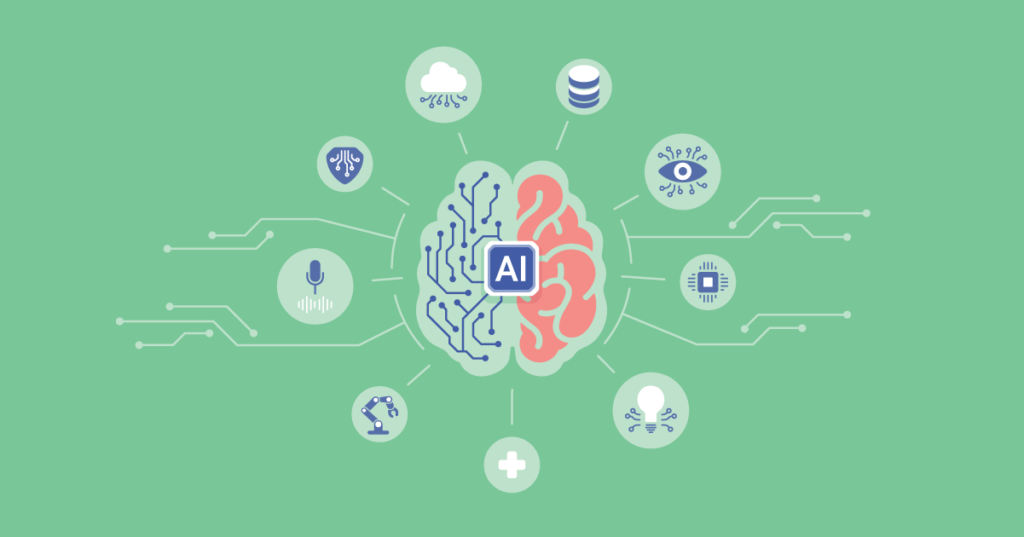
Artificial Intelligence (AI) significantly shapes the way we live. It’s the invisible hand behind many conveniences we often take for granted. For instance, AI helps keep our inboxes tidy by filtering out unwanted spam emails. It’s also the technology that warns us about potential scam calls. When we effortlessly unlock our phones with a glance or a touch, that’s AI working with facial recognition and fingerprint scanning. These are just a few examples of how AI seamlessly integrates into our daily routines, making complex tasks simple. Now, let’s dive deeper into how AI enhances various aspects of our everyday lives.
- Image and speech recognition: AI algorithms can be trained to identify objects, people, and speech in images and audio recordings.
- Robotics: AI can be used to control and automate robots, making them more intelligent and able to perform a wider range of tasks.
- Self-driving cars: AI can be used to process sensor data, such as cameras and lidar, to enable cars to drive autonomously.
- Virtual assistants: AI can be used to create virtual assistants that can understand and respond to natural language commands, such as Siri and Alexa.
- Predictive analytics: AI can be used to analyze large data sets and make predictions about future events, such as customer behavior, stock prices, and healthcare outcomes.
- Personalization: AI can be used to personalize experiences for users, such as recommending products and services based on their preferences and behavior.
- Healthcare: AI can be used to analyze medical images, such as X-rays and CT scans, and to develop personalized treatment plans for patients.
- Education: AI can be used to personalize learning experiences for students and to develop educational materials and assessments.
Benefits of AI Technology
Artificial Intelligence (AI) offers a multitude of benefits, transforming various aspects of our lives. Let’s explore some of the key advantages:
Improved Efficiency and Productivity
- AI technology automates repetitive tasks, allowing humans to focus on more complex and creative endeavors. This leads to increased efficiency and productivity across industries.
Continuous Operation
- AI works tirelessly, 24/7, without the need for breaks or downtime.
- Unlike humans, it doesn’t require rest, food, or sleep
Enhanced Decision-Making
- AI processes data swiftly, providing valuable insights.
- It assists in making informed decisions across domains, from finance to healthcare.
Reduction in Human Error
- One of the biggest benefits of artificial intelligence is that it can significantly reduce errors and increase accuracy and precision.
- The decisions taken by AI in every step are decided by information previously gathered and a certain set of algorithms. When programmed properly, these errors can be reduced to null.
Zero Risks
- Another big benefit of AI is that humans can overcome many risks by letting AI robots do them for us.
- Whether it be defusing a bomb, going to space, or exploring the deepest parts of oceans, machines with metal bodies are resistant in nature and can survive unfriendly atmospheres.
- Moreover, they can provide accurate work with greater responsibility and not wear out easily.
Daily Applications
- Today, our everyday lives are entirely dependent on mobile devices and the internet.
- We utilize various apps, including Google Maps, Alexa, Siri, Cortana on Windows, OK Google, taking selfies, making calls, responding to emails, etc. With the use of various AI-based techniques, we can also anticipate today’s weather and the days ahead.
Conclusion
AI is reshaping our world, from enhancing productivity to solving complex problems. As we continue to advance AI technology, ethical guidelines and responsible development are paramount. Let’s embrace the potential of AI while ensuring it benefits humanity as a whole.
Remember, the journey into AI begins with curiosity and a willingness to learn. Explore online courses, experiment with projects, and join the AI revolution!
FAQ
What is AI technology, and how does it differ from traditional computing?
- AI technology refers to the development of computer systems capable of performing tasks that typically require human intelligence. Unlike traditional computing, which follows predefined instructions, AI systems learn from data and adapt their behavior accordingly.
What are the main types of AI technology?
- The main types of AI technology include narrow AI (or weak AI) and general AI (or strong AI). Narrow AI specializes in specific tasks or domains, while general AI aims to exhibit human-like intelligence across a wide range of activities.
What are some examples of AI technology in everyday life?
- Examples of AI technology in everyday life include virtual assistants like Siri and Alexa, recommendation systems on streaming platforms like Netflix, and autonomous vehicles.
What are the limitations of current AI technology?
- Current limitations of AI technology include interpretability, scalability, data quality, and the inability to exhibit true understanding or consciousness.
In a Rush? Dive into Our Bite-Sized Web Stories!
If time is tight, explore our web stories—they’ll help you achieve your goals faster.